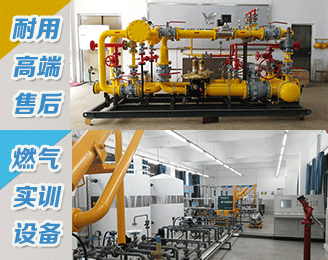
Industrial and Commercial/Boiler/Combustion Pressure Regulation Solutions
RTZ-8/1.7 (L6C, L67CF) Gas Pressure Regulator
◉ Application
This pressure regulator is widely used for first-stage pressure reduction in gas supply systems and is also suitable for industrial gas control systems.Applicable Gases: Natural gas, non-corrosive gases, air
◉ Features
This regulator is of the direct-acting type, with the following characteristics:
- Compact size
- Easy installation
- High pressure-bearing capacity
- Excellent pressure regulation and shut-off performance

◉ Technical Parameters
- Inlet Pressure (P₁): ≤ 17.2 bar
- Outlet Pressure (P₂):
- 0 - 1.4 bar
- 0 - 2.4 bar
- 0 - 4.1 bar
- 0 - 8.6 bar
- Pressure Stabilization Precision (A): AC 5
- Shut-off Pressure (Pᵦ): SG 10
- Flow Rate: 20 Nm³/h (Note: "Nm³/h" = "normal cubic meters per hour", a standard unit for gas flow measurement under standard conditions of 0 °C and 1 standard atmospheric pressure)
- Operating Temperature: -29 °C ~ 82 °C
- Nominal Diameter (DN): DN 8×DN 8
- Connection Type: NPT thread (Note: "NPT" = "National Pipe Thread Taper", a North American standard tapered thread designed for sealed pipe connections, ensuring tightness to prevent gas leakage)

Supplementary Notes on Key Terms
- First-stage Pressure Reduction: In multi-stage gas pressure regulation systems, the "first stage" is the initial step of reducing high-pressure gas (e.g., gas from long-distance pipelines or high-pressure storage tanks) to a medium-pressure level. This regulator’s high inlet pressure tolerance (≤17.2 bar) and wide outlet pressure range (0 - 8.6 bar) make it suitable for this critical pre-regulation step.
- Direct-acting Type: A regulator that uses the pressure of the regulated gas itself to drive internal components (e.g., diaphragms, valve cores) for pressure adjustment, without external power (such as electricity or compressed air). Its simple structure aligns with the "compact size" and "easy installation" features highlighted.
- Non-corrosive Gases: Gases that do not react chemically with the regulator’s internal materials (e.g., metals, seals) to cause rust, erosion, or material degradation—this ensures the regulator’s long-term stable operation when handling gases other than natural gas or air.